

Biodiversity Net Gain is extending to Nationally Significant Infrastructure Projects. On 4 June 2026, Defra confirmed the mandatory start date, laid gain statements in Parliament, and published the first batch of guidance. Here is what NSIP developers, ecological consultancies, and habitat banks need to know.
BNG for NSIPs Is Now Confirmed
The final biodiversity gain statements for Nationally Significant Infrastructure Projects have been formally laid in Parliament and are now published on GOV.UK. Together with two statutory instruments that came into force in May 2026 — amending the Planning Act 2008 via Schedule 15 of the Environment Act 2021 — this confirms the mandatory start date: 2 November 2026.
Any application for a Development Consent Order (DCO) submitted on or after that date must deliver at least 10% biodiversity net gain. The implementation date has slipped twice before — from November 2025 to May 2026 to November 2026 — but the legislation is now enacted and the gain statements are in place. BNG for NSIPs is happening.
The 10% target is consistent with the existing BNG regime under the Town and Country Planning Act (TCPA), which has applied to major and minor development since early 2024. But the way BNG works for NSIPs differs in several important respects.
What Are Nationally Significant Infrastructure Projects?
Nationally Significant Infrastructure Projects are the largest developments in England. They bypass the normal local planning system and require a Development Consent Order from the relevant Secretary of State, following examination by the Planning Inspectorate. The threshold for classification as an NSIP varies by sector, but these are major schemes by any measure.
NSIP categories include:
- Roads — major highways and trunk road schemes (e.g. the Lower Thames Crossing, M3 Junction 9)
- Railways — new lines, major upgrades and rail freight interchanges (e.g. East West Rail, Transpennine Route Upgrade)
- Energy generation — nuclear power stations, onshore generating stations above 50MW, offshore wind farms above 100MW (e.g. Sizewell C, Lime Down Solar Park)
- Electricity transmission — overhead lines, underground cables, interconnectors and substations (e.g. Norwich to Tilbury, Bramford to Twinstead)
- Gas and oil infrastructure — pipelines, gas reception facilities, underground gas storage
- Water — reservoirs, water transfer schemes, desalination plants (e.g. the proposed South East Strategic Reservoir)
- Waste — hazardous waste facilities, wastewater treatment works (e.g. Cambridge Waste Water Treatment Plant Relocation)
These projects share a common characteristic: they disturb large areas of land, often across multiple local authority boundaries, and they rarely have the space or practical ability to compensate for habitat loss entirely within their development footprint.
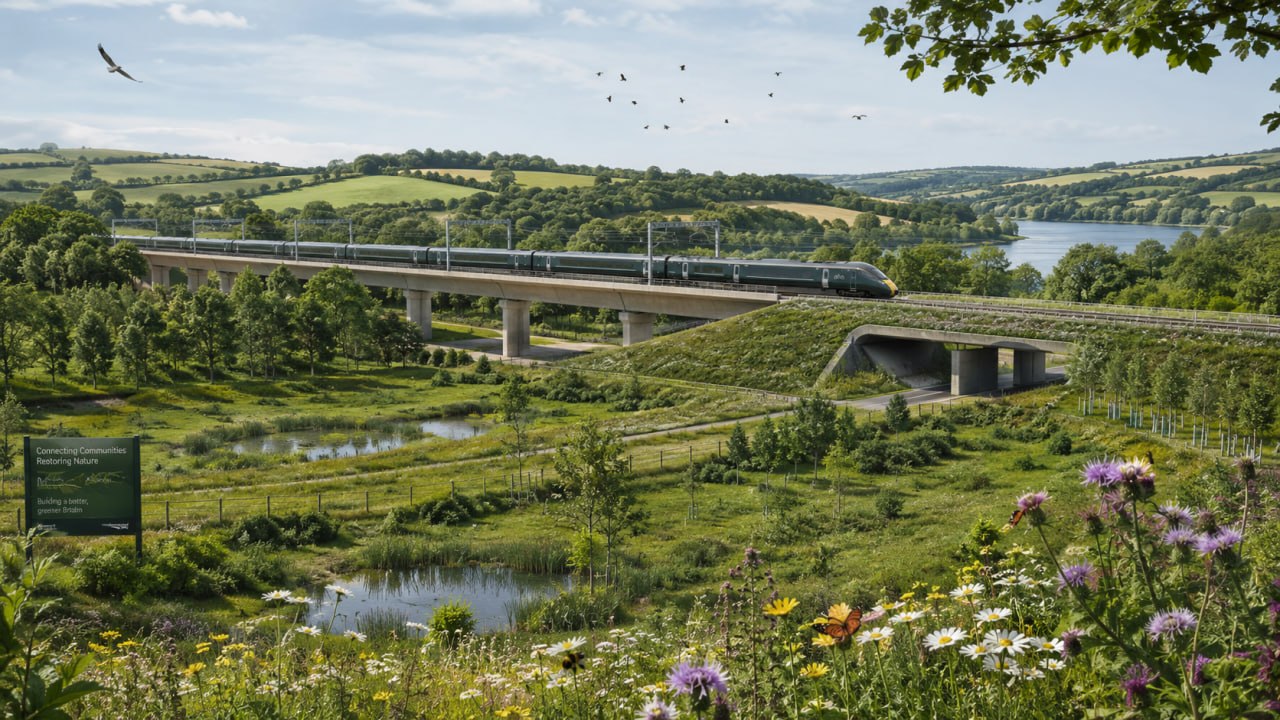
Large infrastructure projects like railways can deliver biodiversity net gain through off-site habitat creation on registered gain sites.
How BNG Requirements Differ for NSIPs
While the 10% biodiversity net gain target is the same as for standard planning applications, several key elements of the NSIP BNG framework differ significantly.
The BNG Boundary Replaces Order Limits
For a standard planning application under the TCPA, the biodiversity baseline covers everything within the red line boundary. For NSIPs, the government has introduced a narrower "BNG boundary". Only habitats actually impacted by the development need to be included in the baseline calculation — not the entire area within the Order Limits.
This is a practical necessity. A 14-mile road tunnel has Order Limits that may stretch across dozens of square kilometres, but the physical footprint that disturbs habitat could be a fraction of that. Requiring the entire Order Limits as the baseline would be disproportionate and would create perverse incentives around how developers draw their boundaries. The baseline guidance published on 2 June 2026 provides further detail on defining the BNG boundary.
On-Site and Off-Site BNG Are Treated Equally
There is no hierarchy preferring on-site delivery for NSIPs. On-site and off-site biodiversity gains are treated as equally valid. This mirrors the recent change for minor development under the TCPA regime, but for NSIPs it was always the more logical approach. A nuclear power station or major road scheme is not going to create meaningful long-term habitat within its operational boundary.
This equal treatment removes any pressure on NSIP developers to use compulsory acquisition powers solely to expand their scheme boundaries for on-site BNG delivery. Instead, they can purchase off-site biodiversity units from registered habitat banks — a faster, more certain, and often more ecologically effective route to achieving the 10% target.
Biodiversity Gain Statements by NSIP Type
Defra has published separate biodiversity gain statements linked to each National Policy Statement, plus one covering NSIPs with no designated NPS. Each statement sets out how to calculate, deliver, and report on biodiversity net gain for that project type. This creates a consistent framework while allowing for sector-specific considerations — energy projects face different ecological challenges to water infrastructure or transport schemes.
Outline Biodiversity Gain Plan Required at Application
DCO applications submitted from 2 November 2026 must include an outline biodiversity gain plan. This does not need to be finalised at the point of application — it can be updated post-consent as the detailed design evolves — but it must demonstrate how the 10% biodiversity net gain target will be met, including any proposed off-site delivery.
For NSIP developers, this means biodiversity planning needs to start early. Engaging ecological consultancies and identifying off-site unit suppliers well before the DCO application is submitted is essential to de-risk the planning timeline.
Temporary Land and the 30-Year Requirement
BNG habitats created for NSIPs must be secured and managed for a minimum of 30 years, consistent with the TCPA regime. However, the government has confirmed that temporary impacts — where land is used during construction and then returned — do not require 30-year legal agreements. This preserves temporary acquisition as a practical tool for developers and landowners, avoiding unnecessary complexity on land that will be restored to its pre-development condition.
The Statutory Biodiversity Metric Applies
NSIPs will use the same statutory biodiversity metric as TCPA developments. The metric user guide has been updated to apply clearly to NSIPs. This means the calculation methodology is familiar to ecological consultancies already working with BNG — the same habitat distinctiveness bands, condition assessments, and spatial risk multipliers apply.
Why NSIPs Will Drive Significant Off-Site BNG Demand
The scale of Nationally Significant Infrastructure Projects sets them apart from the standard planning applications that have driven the off-site BNG market since February 2024.
Consider the numbers. A typical TCPA development might need 0.5 to 5 biodiversity units of off-site delivery. A major road scheme that impacts 50 hectares of grassland and scrub could easily generate a requirement for hundreds of biodiversity units. A single solar farm above 50MW might need dozens. These are bulk orders of a kind that the off-site market has not yet seen.
The government acknowledged in its consultation response that NSIPs represent "a huge opportunity for landscape-scale interventions, funnelling significant private capital investment into the unit market." With on-site and off-site treated equally and no practical expectation that infrastructure projects will deliver net gain within their footprint, the off-site market is about to receive a substantial injection of demand.
For developers, this makes early engagement with habitat banks critical. Unlike standard planning applications where off-site units can sometimes be secured after permission is granted, NSIP developers need to demonstrate off-site supply in their outline biodiversity gain plan at the DCO application stage. Waiting until post-consent to identify suppliers adds risk to already complex and time-pressured NSIP timelines.
Statutory Biodiversity Credits: The Last Resort
Where an NSIP developer cannot secure enough biodiversity units either on-site or through off-site habitat banks, the statutory biodiversity credit system provides a backstop. Credits are purchased directly from the government, and the revenue is used to fund habitat creation elsewhere in England.
However, statutory credits are deliberately priced well above the market rate for off-site units — they are designed as a last resort, not a routine option. For NSIP developers dealing with large unit requirements, the cost differential between credits and off-site units from a registered habitat bank is substantial. Securing off-site units early is almost always the more cost-effective route. View off-site BNG units available from The Ferals.
What This Means for Habitat Banks
For registered habitat banks with significant unit inventories, the NSIP mandate creates a new tier of demand. The characteristics of NSIP BNG requirements align closely with what habitat banks are designed to deliver:
- Volume — NSIPs will need large quantities of units, favouring banks with substantial available inventory over smaller gain sites
- Certainty — developers need to demonstrate supply at application stage, favouring banks that are already registered and operational
- Speed — NSIP timelines are long and complex, but BNG planning needs to happen early; banks with units ready to allocate have a clear advantage
- Habitat quality — the metric rewards higher distinctiveness and better condition; well-managed habitat banks deliver genuine ecological outcomes, not token interventions
The Ferals is a registered biodiversity gain site on the Natural England BNG Register (BGS-180925001), delivering approximately 500 biodiversity units across 250 acres in Tarrant Keyneston, Dorset. We supply medium and high distinctiveness habitat types including other neutral grassland, mixed scrub, hedgerow, and rural tree units — exactly the habitat types that NSIPs most commonly need to offset.
Off-Site BNG Supply for NSIPs in Southern England
Southern England has a significant concentration of NSIP activity — large-scale solar, transmission infrastructure, road and rail schemes, and emerging energy projects across Dorset, Wiltshire, Hampshire, Somerset, and the wider south west. Many of these are already in the Planning Inspectorate pipeline, with DCO applications expected before or shortly after the November 2026 deadline.
Habitat banks located within practical trading distance of these projects are well positioned to supply the off-site biodiversity units that NSIP developers will need. Registered gain sites with large inventories, established habitat creation programmes, and the capacity to service bulk orders will be in demand as the mandate takes effect. Learn more about off-site BNG in Dorset.
Timeline: Key Dates for BNG and NSIPs
- February 2024 — BNG became mandatory for major TCPA applications
- April 2024 — BNG extended to minor TCPA applications
- 15 April 2026 — Government published consultation response confirming BNG for NSIPs
- May 2026 — Two statutory instruments came into force, amending the Planning Act 2008
- 2 June 2026 — First batch of NSIP BNG guidance published, including baseline guidance and metric user guide updates
- 4 June 2026 — Biodiversity gain statements formally laid in Parliament
- 2 November 2026 — BNG becomes mandatory for all NSIP applications submitted from this date
Defra has indicated that further guidance will follow before November to support a smooth transition. But the legislative framework is complete. NSIP developers preparing DCO applications for submission later this year should already be engaging ecological consultancies, commissioning biodiversity metric calculations, and identifying off-site delivery options.
How to Source Off-Site BNG Units for an NSIP
The process for purchasing off-site biodiversity units for an NSIP is the same as for standard planning applications, but the scale and timing considerations are different.
- Commission your biodiversity metric — your ecological consultancy calculates the baseline biodiversity value within the BNG boundary and the post-development value, identifying the off-site unit deficit
- Identify habitat bank suppliers — look for registered gain sites on the Natural England register with sufficient inventory, appropriate habitat types, and reasonable spatial risk multipliers for your project location
- Agree terms and reserve units — secure a commercial agreement with the habitat bank, including unit quantities, pricing, and allocation timeline
- Include in your outline biodiversity gain plan — demonstrate the off-site supply arrangement in your DCO application
- Formal allocation — units are formally allocated on the Natural England register, completing the legal chain
For a detailed walkthrough of the purchasing process, see our guide: How to Buy BNG Units: From First Enquiry to Natural England Allocation.
The Bigger Picture: BNG Is Maturing
When biodiversity net gain became mandatory for major TCPA applications in February 2024, the off-site market was still finding its feet. Registered habitat banks were scarce. The biodiversity metric was unfamiliar to many. Legal templates were being developed.
Two years on, the infrastructure is maturing. There are registered gain sites across the country. The metric is well understood. Legal agreements are standardised. Conservation covenants and Section 106 mechanisms are well tested. And now the same framework is extending to the largest developments in England.
NSIPs joining the BNG regime is not a revolution — it is the logical next step in a policy that was always designed to cover all development types. Schedule 15 of the Environment Act 2021 was drafted with NSIPs in mind from the start. The delay in implementation was about getting the detail right, not about whether it would happen.
For habitat banks with the capacity to service large orders, November 2026 marks the opening of a significant new market. For NSIP developers, it means the same thing BNG has always meant for everyone else: plan early, engage your ecologist, and secure your units before you need them.
Frequently Asked Questions: BNG for NSIPs
When does BNG become mandatory for NSIPs?
Biodiversity Net Gain becomes mandatory for Nationally Significant Infrastructure Projects from 2 November 2026. Any application for a Development Consent Order submitted on or after that date must deliver at least 10% biodiversity net gain.
What is the BNG boundary for NSIPs?
For NSIPs, a new "BNG boundary" replaces the full Order Limits for baseline calculation. Only habitats actually impacted by the development need to be included, rather than everything within the red line boundary. This is especially significant for large linear schemes like roads and railways where the Order Limits can extend far beyond the physical footprint.
Can NSIP developers use off-site biodiversity units?
Yes. For NSIPs, on-site and off-site biodiversity gains are treated as equal — there is no hierarchy requiring on-site delivery first. NSIP developers can purchase off-site BNG units from registered habitat banks to meet the 10% biodiversity net gain requirement.
What types of projects are classified as NSIPs?
Nationally Significant Infrastructure Projects include major roads, railways, power stations, offshore wind farms, solar farms above 50MW, gas pipelines, electricity transmission infrastructure, water infrastructure, and hazardous waste facilities. They require a Development Consent Order from the Secretary of State rather than a standard planning application.
Do NSIP developers need a biodiversity gain plan?
Yes. NSIP applications must include an outline biodiversity gain plan demonstrating how the 10% net gain target will be met, including any proposed off-site delivery. The plan can be updated post-consent as detailed design evolves.
How many biodiversity units will NSIPs typically need?
NSIPs are large-scale projects that can disturb significant areas of habitat. A major road scheme impacting 50 hectares could require hundreds of biodiversity units. Even smaller NSIPs like solar farms above 50MW are likely to need dozens of off-site units — far exceeding the typical requirement for standard planning applications.
Can a habitat bank supply BNG units for an NSIP?
Yes. Registered habitat banks on the Natural England Biodiversity Gain Sites Register can supply off-site BNG units for NSIPs, using the same allocation process as for TCPA developments. Habitat banks with large unit inventories are particularly well suited to NSIP-scale requirements.
What are statutory biodiversity credits and when are they used?
Statutory biodiversity credits are a last-resort option for developers who cannot secure enough biodiversity units on-site or through off-site habitat banks. Credits are purchased from the government at a significantly higher price than off-site units, making habitat bank units the more cost-effective option for NSIP developers.
Sources: Defra blog — BNG for NSIPs: gain statements laid and guidance published (4 June 2026) · GOV.UK — BNG for NSIPs guidance collection · GOV.UK — BNG baselines for NSIPs