
Hampshire County Council published its Local Nature Recovery Strategy in December 2025 — one of the first LNRSs in England to go live. If you are delivering a development anywhere in Hampshire and need off-site BNG units, this strategy now shapes where those units should come from and how they are valued in the metric.
Here is what matters for developers and their ecological consultants.
What the Hampshire LNRS Covers
The Hampshire LNRS covers the entire county — every local planning authority within it. That includes Winchester City Council, New Forest District Council, East Hampshire District Council, Test Valley Borough Council, Basingstoke and Deane Borough Council, Hart District Council, Rushmoor Borough Council, Havant Borough Council, Fareham Borough Council, Gosport Borough Council, Eastleigh Borough Council, and the unitary authorities of Southampton and Portsmouth. The New Forest National Park Authority and the South Downs National Park Authority (for the parts within Hampshire) are also covered.
This is a single strategy area for the purposes of BNG spatial risk assessment. Any registered habitat bank within the Hampshire LNRS area can supply off-site units to any development within it — with no spatial risk penalty.
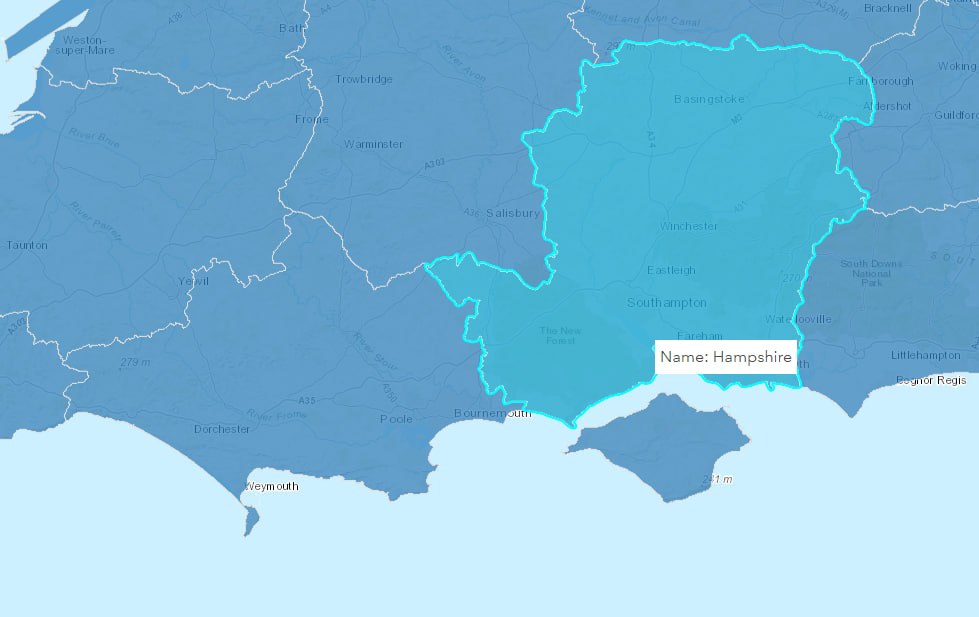
The Hampshire LNRS boundary (highlighted). Dorset — where The Ferals is located — sits immediately to the west as a neighbouring LNRS area.
Hampshire's Habitat Priorities
The strategy identifies 52 priority outcomes and 69 potential measures for nature recovery. The headline habitat priorities are directly relevant to BNG delivery:
- Chalk grassland — Hampshire holds around 2,800 hectares of nationally important calcareous grassland, much of it fragmented across downland slopes and escarpments. The LNRS prioritises restoration and creation of species-rich grassland, particularly through reversion of arable land.
- Heathland and acid grassland mosaics — significant areas in the New Forest, Thames Basin Heaths and Wealden Heaths, designated as internationally important. Recovery efforts focus on restoration, expansion and linkage of fragmented heathland.
- Woodland and wood pasture — including restoration of Planted Ancient Woodlands, creation of new wood pasture, and management of edge habitat and veteran trees.
- Wetlands and rivers — Hampshire's chalk streams are globally rare habitats, with the strategy targeting riparian buffer zones and floodplain reconnection.
For developers, these priorities matter because they shape where the county wants to see habitat creation and enhancement — and increasingly, where local planning authorities expect off-site BNG to be directed.
What This Means for Developers in Hampshire
For any development in Winchester, New Forest, East Hampshire, Test Valley or elsewhere in the county, the LNRS creates a clear framework for off-site BNG:
- Within Hampshire: Off-site units from a habitat bank inside the Hampshire LNRS area attract no spatial risk penalty. The units count at full value in the metric.
- Local supply is limited: Hampshire's urban areas (Southampton, Portsmouth, the Solent corridor) have very little land available for habitat creation. Rural habitat banks — whether within Hampshire or in neighbouring LNRS areas — are where the units will come from.
Cross-Boundary Delivery: The Spatial Risk Multiplier
Not all off-site BNG units need to come from within the same LNRS area. The statutory biodiversity metric allows cross-boundary delivery, subject to a spatial risk multiplier.
Under the current framework, off-site units sourced from a neighbouring LNRS area attract a multiplier of 0.75. In practice, this means the units contribute 75% of their face value to the metric — so a development needs roughly a third more units to achieve the same BNG outcome compared to sourcing locally.
The Dorset LNRS area and the Hampshire LNRS area share a boundary. They are neighbours. This means a registered habitat bank in Dorset can supply units to Hampshire developments with the neighbouring-area multiplier applied.
Why a Dorset Habitat Bank Can Work for Hampshire Developments
A spatial risk multiplier of 0.75 sounds like a penalty — and technically it is. But it does not necessarily make cross-boundary delivery uncompetitive. Here is why:
- Pricing absorbs the multiplier. A habitat bank that prices its units competitively can offset the additional volume a developer needs. The question is total cost to the developer, not the per-unit multiplier in isolation.
- Supply within Hampshire is constrained. The county's habitat bank market is still developing. For developments that need units now — particularly larger schemes with significant off-site requirements — a registered habitat bank with available supply in a neighbouring LNRS area is a practical solution.
- Ecological connectivity. The chalk landscapes of north Dorset and south-west Hampshire are continuous — the county boundary is administrative, not ecological. The Martin Down area straddles the Hampshire–Dorset border as a nationally important chalk grassland site. Habitat creation at the Dorset end of the same chalk ridge benefits the same wildlife populations that the Hampshire LNRS is trying to recover.
The Ferals — Registered Habitat Bank on the Dorset–Hampshire Border
The Ferals is a 250-acre BNG habitat bank based in Tarrant Keyneston, in the chalk downland of north Dorset — approximately 20 miles from Winchester and within the same chalk landscape that extends into Hampshire. We are registered on the Natural England BNG Register (reference BGS-180925001).
We offer:
- Area habitat units across multiple distinctiveness bands, with a focus on chalk grassland creation — a priority habitat in both the Dorset and Hampshire LNRSs
- A site in the neighbouring Dorset LNRS area, with the spatial risk multiplier transparently factored into our pricing
- Available supply and a straightforward purchasing process with clear pricing and legal agreements
We believe our units are competitive for Hampshire developments even with the spatial risk multiplier applied. The simplest way to find out is to send us your metric — we will return a quote within 48 hours so you can compare it against any other option on the table.
Which Hampshire Councils Does This Apply To?
Every local planning authority within the Hampshire LNRS area. If your development is in any of the following, this article is relevant to you:
- Winchester City Council
- New Forest District Council / New Forest National Park
- East Hampshire District Council
- Test Valley Borough Council
- Basingstoke and Deane Borough Council
- Hart District Council
- Rushmoor Borough Council
- Havant Borough Council
- Fareham Borough Council
- Gosport Borough Council
- Eastleigh Borough Council
- Southampton City Council
- Portsmouth City Council
- South Downs National Park Authority (Hampshire portion)
Get in Touch
If you are working on a development in Hampshire and need off-site BNG units, we would welcome the chance to quote. Contact us at [email protected] or use our contact form with your metric attached, and we will get back to you with pricing.
Sources: Hampshire County Council — Local Nature Recovery Strategy (December 2025) · Defra — Biodiversity Net Gain: What's Changing (April 2026) · Dorset Council — Local Nature Recovery Strategy