
On 14 July 2026, Defra laid The Biodiversity Gain (Town and Country Planning) (Amendments and Transitional Provisions) (England) Regulations 2026 (SI 2026/790) before parliament. These regulations give legal effect to the first batch of BNG changes announced in the government’s consultation response in April.
Four changes come into force on Thursday 6 August 2026. They are no longer proposals. They are law. Below is what is changing, why it matters, and what the numbers actually tell us about the impact on the off-site BNG market.
Update, 4 August 2026: These changes take legal effect this Thursday, 6 August. If your minor development site is above 0.2 hectares, off-site delivery is now a first-choice compliance route from the outset — see current BNG unit prices or the units available now from our registered Dorset gain site.
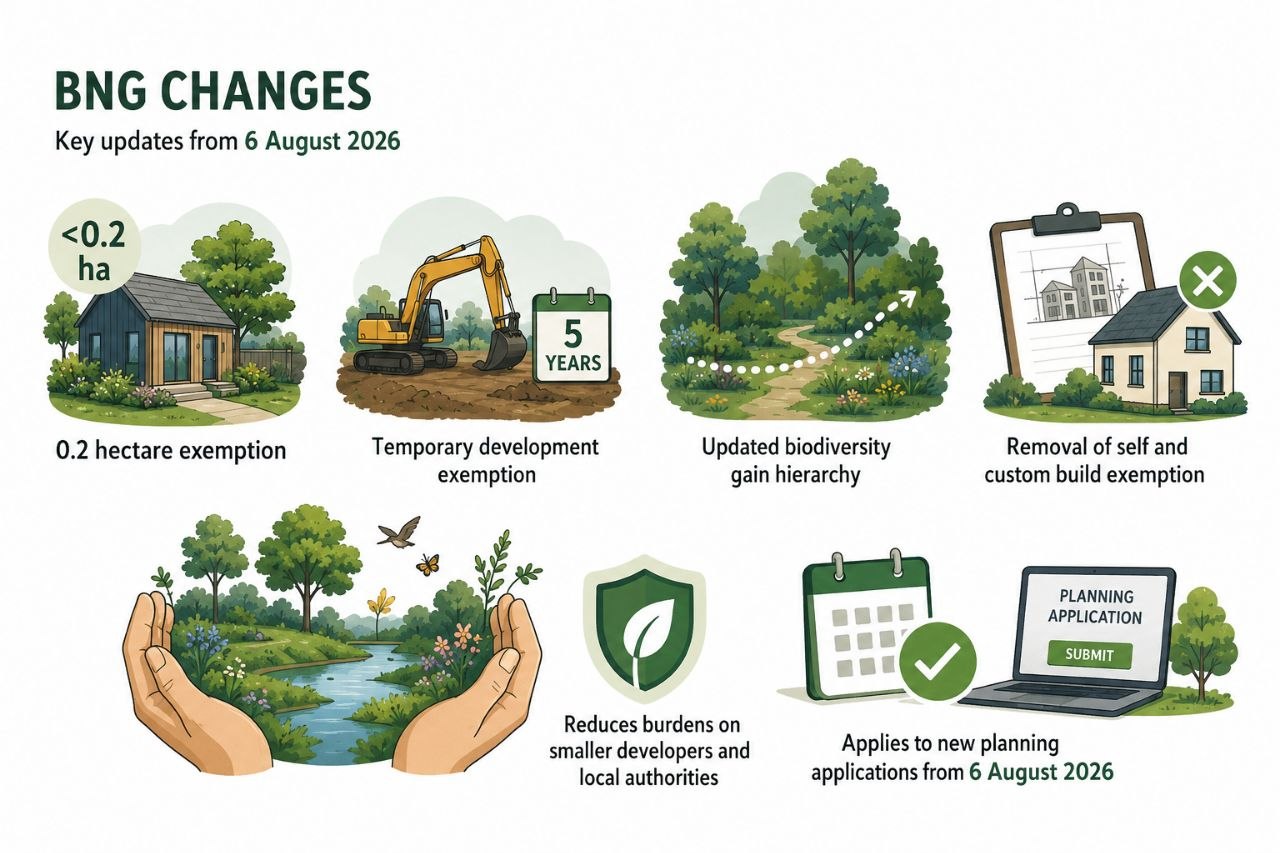
1. The 0.2 Hectare BNG Exemption
Developments with a red line site area of 0.2 hectares or less will be exempt from mandatory BNG from 6 August, provided no on-site priority habitat is negatively impacted.
This threshold is measured by the planning red line boundary, not the developable area. It is simple to apply and straightforward for local planning authorities to verify - a deliberate contrast with some of the harder-to-enforce exemptions it partially replaces.
The numbers
The government's own impact assessment is candid. The 0.2 hectare exemption is expected to remove approximately 50% of residential planning permissions from mandatory BNG. That is a striking headline figure, but the biodiversity impact is more contained: around 12% fewer baseline biodiversity units will be compensated, and off-site demand is projected to fall by roughly 10%.
The reason for the disparity is straightforward. The smallest sites generated relatively few biodiversity units each. Removing a large number of small obligations has a modest effect on the total volume of units demanded. The schemes that remain in scope - everything above 0.2 hectares - tend to be larger, more complex, and significantly more likely to need off-site solutions.
Priority habitat carve-out
The exemption does not apply where the development impacts on-site priority habitat. A development "impacts" a habitat if it decreases its biodiversity value. This carve-out also applies to the de minimis exemption and the new temporary development exemption - it is a shared safeguard across all three.
2. New Temporary Development BNG Exemption
A new exemption applies to temporary developments where:
- the entire development is temporary, and
- planning permission is granted for five years or less
The logic is that applying a 30-year habitat management commitment to a development designed to be removed within five years creates a disproportionate cost. If the land is reinstated to its prior condition, the biodiversity case for mandatory off-site compensation is weak.
This exemption is narrower than it might first appear. It applies only where the whole development is temporary - mixed schemes with permanent elements will not qualify. And the priority habitat carve-out applies: if temporary works damage priority habitat on site, BNG still applies in full.
The exemption covers scenarios like temporary construction compounds, meanwhile uses, and pop-up commercial structures with short-term permissions. It will not cover phased developments where individual phases are labelled "temporary" but the overall scheme is permanent.
3. Off-Site BNG Hierarchy Change for Minor Development
This is the most significant change for the off-site BNG market.
For minor developments that remain subject to BNG (i.e. those above 0.2 hectares but below major development thresholds), the biodiversity gain hierarchy has been modified. Off-site BNG delivery is now placed on equal footing with on-site habitat creation.
Under the previous hierarchy, developers were expected to maximise on-site gains first, turning to off-site units only where on-site delivery was demonstrably impractical. In practice, this meant constrained sites attempted to squeeze marginal habitat into leftover corners - narrow wildflower strips behind garages, token planting on land earmarked for car parking. The biodiversity outcomes were often poor, the management burden was real, and the process of demonstrating that on-site delivery was insufficient added cost and delay.
That distinction is now removed for minor schemes. A developer with a 0.5 hectare residential site can choose to purchase off-site biodiversity units from a registered habitat bank from the outset, without first exhausting on-site options. The ecological argument is sound: a well-managed habitat bank delivering landscape-scale habitat creation will produce better outcomes than scattered micro-interventions on constrained building plots.
The consultation received over 25,000 responses. The government explicitly noted that many developers and planning consultants had requested this change, citing "questionable design outcomes and long-term management risks" from forced on-site delivery on tight sites. The change applies only to minor development - major schemes will continue to follow the existing hierarchy.
4. Self-Build and Custom Build BNG Exemption Removed
The existing exemption for self-build and custom housebuilding development is removed for all new planning applications submitted on or after 6 August 2026.
This was one of the more problematic exemptions in practice. Eligibility depended on applicants' stated intentions about future construction, occupation and retention of the dwelling. Local authorities had limited ability to verify these claims and struggled to enforce compliance after permission was granted. As Anthony Collins Solicitors noted, some councils had resorted to drafting "highly bespoke section 106 agreements" to manage the risk.
The practical impact on developers is limited. The previous self-build exemption covered schemes of up to nine dwellings on sites no larger than 0.5 hectares. Most single-dwelling self-builds will fall comfortably within the new 0.2 hectare exemption, which is simpler and does not require proof of self-build status. Larger self-build projects above 0.2 hectares will now need to comply with BNG - but they can take advantage of the hierarchy change and go straight to off-site units.
What These BNG Changes Mean for the Off-Site Unit Market
The headlines suggest the 0.2 hectare exemption is the centrepiece. In terms of the number of applications affected, it is. But for the off-site BNG market, the hierarchy change is more consequential.
The exemption removes demand - the government projects around 10% less off-site demand. But the hierarchy change creates demand by removing the friction that previously pushed minor developers towards reluctant on-site delivery. Sites between 0.2 hectares and the major development threshold can now legitimately start with off-site as the preferred route, rather than treating it as a fallback.
These two effects pull in opposite directions. The net result is a market that concentrates on developments where BNG delivers genuine biodiversity value, with the off-site route explicitly endorsed as a first-choice option for a large category of schemes.
Combined with BNG becoming mandatory for NSIPs from 2 November 2026, the second half of 2026 represents a material reshaping of the demand profile for off-site biodiversity units.
What Is Still Coming
These four changes are the first batch. Defra has confirmed that further changes will follow, though implementation dates have not yet been set:
- Biodiversity conservation exemption - development whose primary objective is to conserve or enhance biodiversity will be exempt (e.g. habitat creation or restoration projects requiring planning permission)
- Parks and public gardens exemption - a targeted exemption for development that enhances parks, playing fields and public gardens, where no priority habitat is impacted
- Statutory biodiversity metric updates - changes to the metric itself, including to open mosaic habitat definitions and a commitment to develop a web-based metric tool
- Spatial risk multiplier reform - replacing the current LPA/NCA-based trading boundaries with Local Nature Recovery Strategy (LNRS) areas, reducing the number of trading geographies from 337 LPA areas to 48 LNRS areas. For developers in our region, this means developments anywhere within the Dorset LNRS boundary can purchase units from habitat banks within the same area at no spatial risk penalty. More significantly, developments in neighbouring LNRS areas — Hampshire, Wiltshire, Somerset and Devon — will be able to purchase from Dorset habitat banks with a smaller spatial risk multiplier than the current LPA/NCA system often imposes
The consultation on a targeted brownfield exemption for certain residential development closed on 10 June. The government will respond in due course, and any changes to the de minimis exemption have been deferred to be considered alongside that response.
Transitional Arrangements
The changes apply to new planning applications submitted on or after 6 August 2026. Planning permissions already granted, and applications already submitted before that date, continue under the existing BNG legislation.
For variations of existing planning permissions: where the original permission was not in scope of mandatory BNG, future variations will generally remain outside scope. The regulations and accompanying Explanatory Memorandum provide further detail. Updated planning practice guidance will follow.
There is no retrospective effect. If you submitted your application before 6 August, the old rules apply - including the old hierarchy requiring on-site delivery first.
Frequently Asked Questions
When do these BNG changes take effect?
All four changes come into force on 6 August 2026 and apply to new planning applications submitted from that date. Applications already submitted continue under the existing BNG rules.
Is my site exempt under the 0.2 hectare threshold?
If your red line site area is 0.2 hectares or less and your development does not negatively impact on-site priority habitat, mandatory BNG will not apply to applications submitted from 6 August. The threshold is measured by the planning red line boundary, not the developable area.
Can minor developments now go straight to off-site BNG?
Yes. For minor developments above 0.2 hectares, the biodiversity gain hierarchy has been modified so that off-site delivery is treated equally to on-site provision. Developers no longer need to demonstrate that on-site delivery is impractical before purchasing off-site biodiversity units.
What happens to self-build developments?
The self-build and custom housebuilding exemption is removed for applications submitted from 6 August 2026. However, most single-dwelling self-builds on sites of 0.2 hectares or less will be covered by the new area-based exemption instead. Larger self-build projects will now need to comply with BNG.
Does the temporary development exemption apply to phased schemes?
No. The exemption only applies where the entire development is temporary and planning permission is granted for five years or less. A permanent development that includes a temporary phase does not qualify.
Do exempt developments still have environmental obligations?
Yes. Developments exempt from mandatory BNG remain subject to all existing environmental protections and planning policies. The mitigation hierarchy still applies, and permission should be refused where significant harm to biodiversity cannot be avoided, adequately mitigated or compensated.
What about the spatial risk multiplier and LNRS trading boundaries?
These changes are part of the second batch and have not yet been given an implementation date. Currently, off-site units are assessed against LPA and NCA boundaries. When the change takes effect, trading will be based on the 48 LNRS areas across England.
How much do off-site BNG units cost in 2026?
Off-site biodiversity units from a registered habitat bank typically cost between £20,000 and £35,000 per unit for medium distinctiveness habitats — well below the statutory biodiversity credits the government sells as a last resort, which start at £42,000 per credit with two credits needed for every unit. See our full BNG unit cost guide for the current price table and the factors that drive it, or read our practical BNG guide for developers for the wider compliance picture.
Where can I buy off-site BNG units?
Off-site biodiversity units must come from land registered on the Natural England Biodiversity Gain Sites Register. The Ferals is a registered gain site in Dorset (BGS-180925001) supplying area habitat units. Read our guide to buying BNG units, browse BNG units for sale, or get in touch with your metric.
Sources: Defra blog - BNG amendments and transitional arrangements published (14 July 2026) · SI 2026/790 - The Biodiversity Gain (Town and Country Planning) (Amendments and Transitional Provisions) (England) Regulations 2026 · GOV.UK - BNG exempt developments (updated 14 July 2026) · Government consultation response (April 2026)