Biodiversity Net Gain units are for sale from registered habitat banks across England — but the process of actually buying them is not always clear. Most guidance explains what BNG is, or how to calculate your requirement. Very little explains what happens after you have found a habitat bank and want to proceed.
This is a step-by-step account of the process at The Ferals, from first contact through to allocation on the Natural England register, with realistic timelines at each stage.
What You Need Before You Start
Before you can buy off-site Biodiversity Net Gain units, you will need a completed Biodiversity Metric 4.0 calculation showing your unit deficit — the number and type of habitat units your development must deliver off-site. Your ecological consultant will produce this as part of the BNG assessment for your planning application.
The metric will tell you the exact habitat types and distinctiveness bands you need. This matters because habitat banks hold specific unit types — not all banks can supply all types. Sending the metric at the outset is the fastest way to confirm whether a habitat bank can meet your requirement.
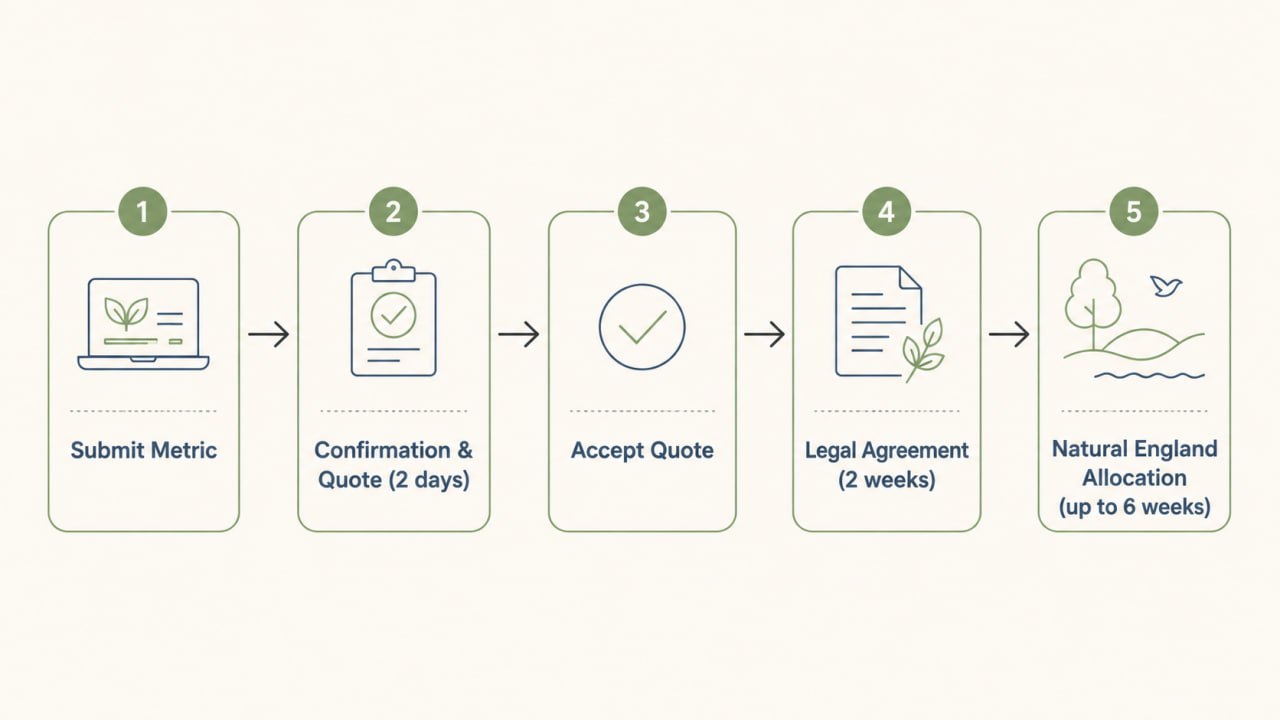
Step 1 — Send Your Metric
Email your Biodiversity Metric 4.0 results to [email protected]. Include the name of the local planning authority, the planning application reference if you have one, and any relevant timing constraints.
You do not need to have an accepted planning application at this stage. Many developers and ecologists approach us during the pre-application or metric preparation phase, and we are happy to confirm availability early to inform the planning strategy.
Step 2 — Confirmation and Quote Within Two Working Days
We will review your metric and confirm within two working days whether The Ferals can supply the habitat units you need. If we can, we will include a quote in the same reply.
The quote sets out the unit types available, the quantity, the price per unit, and the total consideration. It also confirms that the units are being held for you while you consider the offer.
At this stage there is no obligation. Many ecologists contact us on behalf of their clients to check availability and pricing before recommending an off-site solution — that is a normal part of the process.
Step 3 — Accepting the Quote
If you wish to proceed, simply confirm acceptance of the quote in writing. This triggers the legal agreement stage.
We will ask for the details required to prepare the legal documentation: the full legal name of the purchasing entity, the development address and planning reference, and the name of the local planning authority. Your solicitor's details are helpful at this point but not essential to get started.
Step 4 — Legal Agreement Within Two Weeks
The purchase of BNG units is formalised through a Section 106 agreement — a legally binding document between The Ferals, the purchasing developer or applicant, and Dorset Council as the responsible body. This agreement secures the habitat creation and management obligations for 30 years.
We prepare the legal document and aim to have it ready for review within two weeks of receiving confirmed instructions. The document sets out the habitat units being sold, the consideration, the management obligations, and the monitoring requirements for the lifetime of the agreement.
Your solicitor will need to review and execute the agreement on your behalf. The timeline for this stage depends partly on the availability of your legal team, but a straightforward transaction typically completes within a few weeks of the document being issued.
Step 5 — Allocation on the Natural England Register
Once the Section 106 agreement is signed, we submit the allocation to the Natural England Biodiversity Gain Sites Register. Natural England confirm that the units have been allocated to your development, and this forms part of the evidence your local planning authority will require to discharge the BNG planning condition.
Natural England state that they will process allocations in up to six weeks from submission. In practice, straightforward allocations are often processed faster, but it is sensible to factor the full six weeks into your programme if you are working to a planning condition discharge deadline.
Total Timeline
From first contact to confirmed allocation on the Natural England register, the full process typically takes between eight and twelve weeks, depending on how quickly the legal agreement is executed. The stages within our control — confirmation, quote, and legal document preparation — are completed within two to three weeks of initial contact. Natural England's processing time is the variable to plan around.
If you are working to a tight planning condition deadline, contact us early. We can confirm availability and hold units informally while legal formalities are being prepared.
Units Currently for Sale at The Ferals
The Ferals is a registered biodiversity gain site (BGS-180925001) in Tarrant Keyneston, Dorset. We currently have the following Biodiversity Net Gain units for sale:
- Other Neutral Grassland units — available now
- Mixed Scrub units — available now
- Individual Tree units (rural) — available now
- Traditional Orchard units — in progress
All units are verified under DEFRA's Biodiversity Metric 4.0 and secured by a 30-year Section 106 agreement with Dorset Council. The site is located within the Cranborne Chase landscape adjacent to the National Trust's Kingston Lacy estate, within the Dorset Local Nature Recovery Strategy area.
We supply off-site Biodiversity Net Gain units to developers and planning applicants in Dorset, Hampshire, Wiltshire, Somerset, and — subject to spatial risk calculations — further afield across southern England.
To enquire about BNG units for sale, or to submit your metric for a no-obligation quote, contact us at [email protected].