A version of this piece was first published in Dorset Wildlife Trust magazine, Spring 2026.
Shoshin is the term from Japanese Zen Buddhism which in English we call "beginner's mind". It's a stance of mental openness and lack of preconceptions even when you are an expert in the field. Happily, I have reached mid-life without expertise; beginner's mind is easy when you're actually a beginner.
From Suburbia to Farm
A slinking suburban fox of a boy with a refugee parent, I did not have farming or the natural world high on my to-do list whilst growing up. So, when I acquired my first herd of cattle, it was a learning challenge. My only knowledge of bovine management was from childhood images of Lord Krishna trilling his flute while surrounded by milk-white heifers. Worth a try, I thought. Imagine my glee when this summer I heard of the growing trend of British farmers playing calming jazz to their cows — and later read the scientific papers about the positive effects of music on animal stress levels.
Rewilding Project
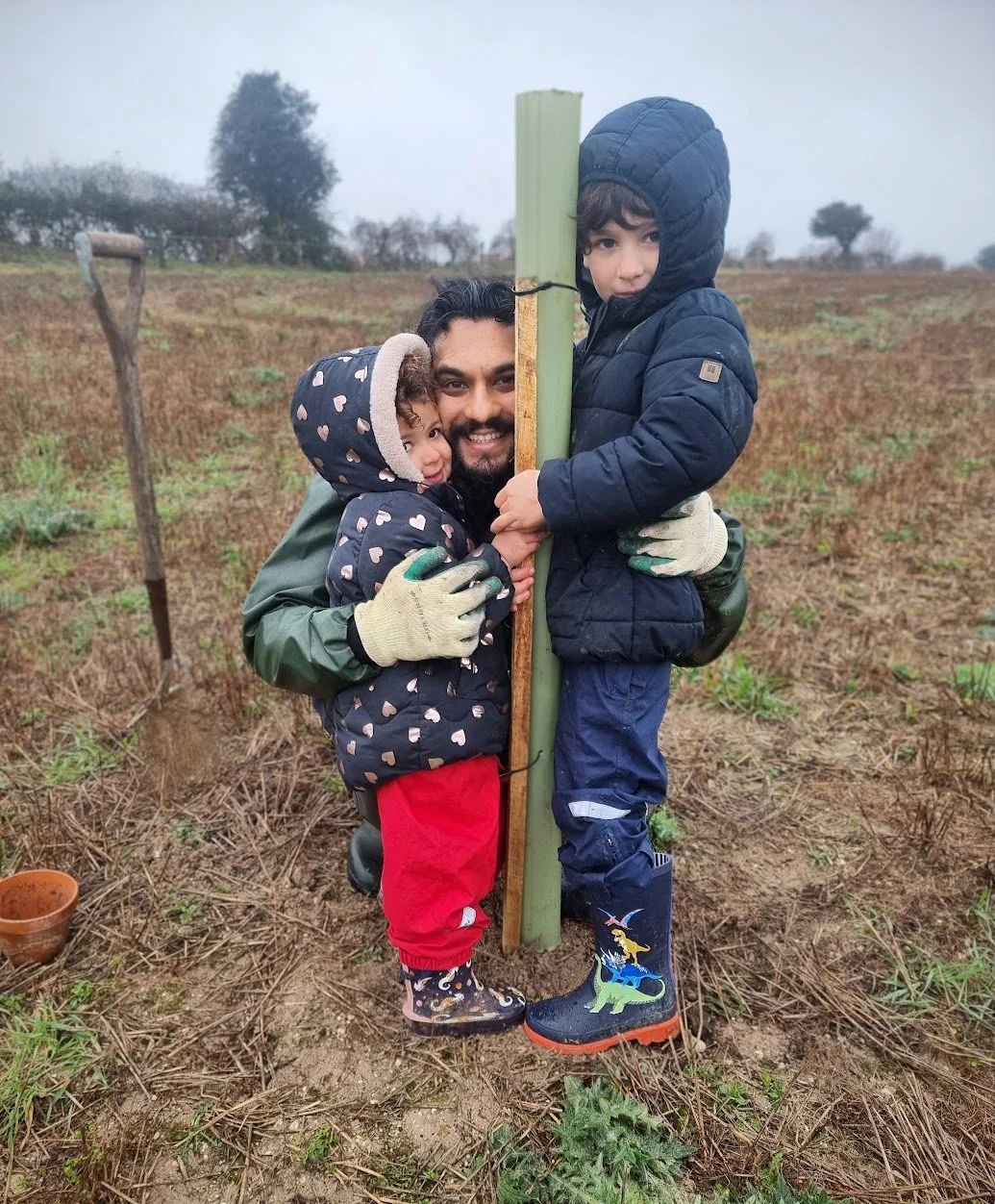
The Ferals, in Tarrant Keyneston, is a 250-acre nature recovery site which I run with my wife, Georgie. It was an intensive arable farm, but year by year we are converting it into a mosaic of wood pasture and wildflower meadows. The most transformative change, however, has been the water. This land sits on a chalk hilltop which makes natural surface water impossible. In the heyday of the dinosaurs when Dorset was a warm tropical sea, the chalk formed when armoured plankton died and their armour plates were compressed into a layer on the seabed. The creation of two ponds and eight scrapes have acted as an ecological warp drive, attracting dragonflies, flocks of linnets, swifts, swallows, mammals, and invertebrates to the water.
Cycles of Creation and Destruction
In Hinduism, there is a trinity, or Trimurti, of gods: Shiva, Brahma, Vishnu — who represent Destruction, Creation, Preservation respectively. Nature recovery is not a static system; it cycles through all three, but we often forget the destruction part. As one laconic Scottish friend put it, "You need a cannon" — which I had assumed meant a camera because everyone goes on about monitoring, but what he actually meant was blowing up the flattened arable landscapes to create the pocks, the holes, the nooks, the crannies as ecological niches for diverse organisms to thrive.
Hedge Laying and Biomimicry
It was in this spirit also that I experimented with conservation hedge laying. People usually know hedge laying as those wonderful, quaint, wreathed designs which spawn fierce inter-county rivalries. While that is a brilliant practice for keeping farm hedges manageable, much of what we do when recovering nature is actually biomimicry. Just over 100,000 years ago in the Pleistocene, massive landscape engineers like the straight-tusked elephant would have roamed the UK, knocking over trees but leaving the vital hinge of bark and cambium intact. This causes the tree to go into emergency survival mode, shooting up vertical new growth from the horizontal trunk. Unable to commission an African elephant for the work, I, as human proxy, hired a digger and — after making a small cut in the base of the plant — used its mechanical arm as the trunk of the pachyderm.
A Single Spot of Wildness
Caricature paints landowners as a polarized species, ranging from gun-wielding 'I-eat-bird-pie' types at one extreme to shivering primitivists sipping their blackberry tea at the other. Tribalism is to community what in-laws are to a spouse; it comes with the territory. But when we wipe off the war paint and tone down the battle cries, it is easy to see that land use is not a binary choice. Producing our own food on these isles is necessary for our physical survival, but nature is a necessity for our very essence. Our souls are not sealed black boxes, but are composed of the sounds we hear, the landscape we see, and the creatures with whom we share it. Into that composition inject a single spot of wildness and it bleeds, like flowing ink through soft paper.
Akshay Sanghrajka is the owner of The Ferals and a Trustee of Dorset Wildlife Trust. The Ferals is a registered Biodiversity Net Gain habitat bank in Tarrant Keyneston, Dorset.
Download the original article as it appeared in the Dorset Wildlife Trust Magazine →