Off-site Biodiversity Net Gain units from a registered habitat bank in Tarrant Keyneston, Dorset. Secured by 30-year legal agreements. Available now for developers across southern England.
BNG units (Biodiversity Net Gain units) are a standardised measure of biodiversity value used to quantify the impact of development on habitats. Every unit is calculated using the DEFRA Biodiversity Metric 4.0, which accounts for habitat area, condition, distinctiveness, and strategic significance.
Under the Environment Act 2021, most developments in England that require planning permission must deliver a minimum 10% biodiversity net gain. Where a development results in habitat loss, the developer must compensate by creating or enhancing habitat either on-site or off-site. Off-site units are purchased from registered habitat banks like The Ferals.
BNG units are not interchangeable. Different habitat types produce different unit types, and the biodiversity metric determines exactly which types and how many a development needs. That is why you need a completed metric before purchasing units.
The Ferals is a registered biodiversity gain site on the Natural England register (reference BGS-180925001). Every unit we sell is legally verified, independently monitored, and backed by a 30-year Section 106 agreement with Dorset Council.
Unlike brokers or intermediaries, we are the habitat bank. You deal directly with the landowner. There is no middleman, no commission markup, and no delay waiting for third-party approvals. When you buy BNG units from The Ferals, you are buying from the source.
The Ferals offers four habitat unit types across our 250-acre site. All units are calculated using the statutory Biodiversity Metric 4.0 and secured through our S106 agreement.
Lowland grassland creation on former arable land. Medium distinctiveness. The most commonly required unit type for residential and commercial developments.
Hawthorn, blackthorn and native scrub creation. Medium distinctiveness. Supports invertebrates, nesting birds and small mammals across the site.
Native tree planting within the rural landscape. Contributes to habitat connectivity across the Tarrant Valley and Cranborne Chase.
Traditional orchard creation with native fruit varieties. High distinctiveness. Provides specialist habitat for invertebrates and foraging birds.
The process of purchasing off-site BNG units is straightforward. Most transactions complete within two to four weeks from first enquiry to allocation on the Natural England register.
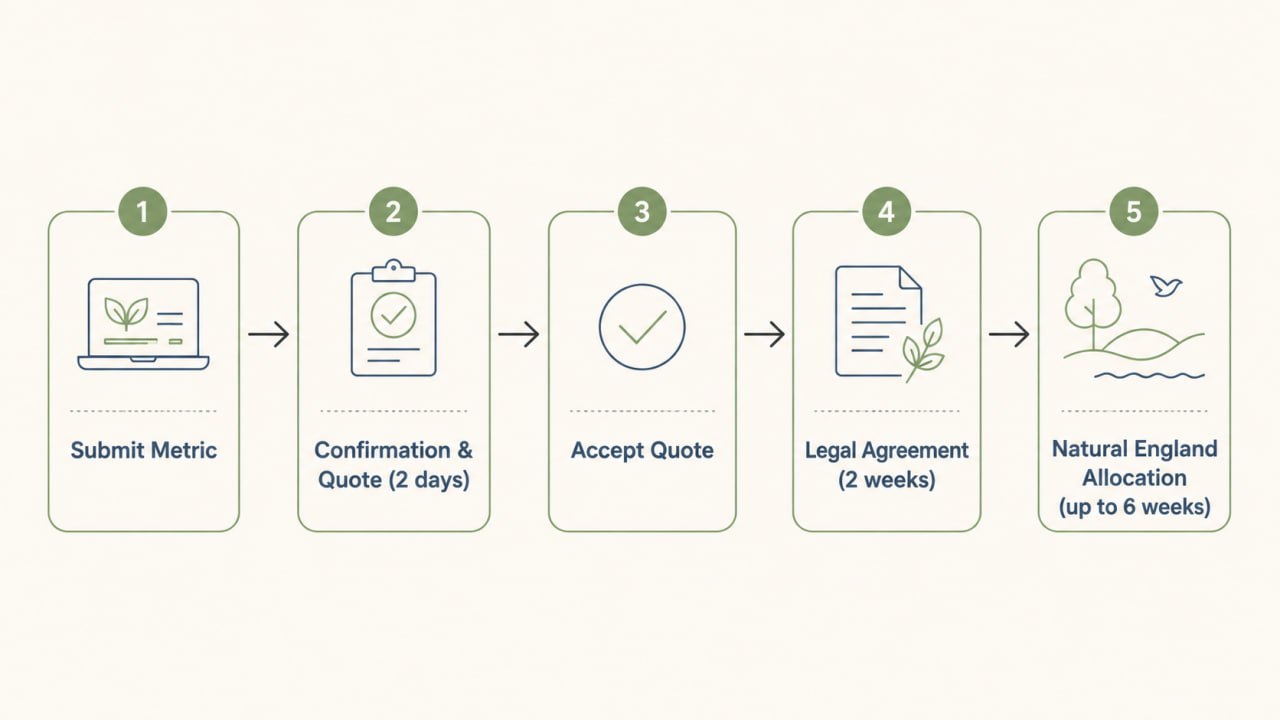
Send us your completed Biodiversity Metric 4.0 spreadsheet. This tells us exactly how many units your development needs and what habitat types are required. If you do not have a completed metric yet, your ecologist can prepare one as part of your planning application.
We review your metric against our available inventory and confirm which units we can supply. We provide a formal quote and habitat unit certificate for your planning application. Most quotes are returned within 48 hours.
Units are secured through a Section 106 agreement with Dorset Council. This is a legally binding agreement that secures the habitat creation and management obligations for 30 years. The legal process typically takes around two weeks.
Once the S106 agreement is in place, units are formally allocated to your development on the Natural England BNG Register. This can take up to six weeks, as per Natural England processing times.
Independent ecologists monitor habitat condition annually for 30 years. You receive monitoring reports confirming your BNG obligations are being met. The developer has no further management liability.
For a detailed walkthrough of the full purchase process, read our guide: How to Buy BNG Units: From First Enquiry to Natural England Allocation.
Any development in England that requires planning permission and triggers the mandatory 10% biodiversity net gain condition may need to purchase off-site BNG units. Our customers include:
Common scenarios where off-site units are required:
BNG unit prices vary depending on several factors, including habitat type, distinctiveness level, location, and market demand. Across the current market, off-site BNG units from registered habitat banks typically range from £10,000 to £25,000 per unit for medium distinctiveness habitats.
Statutory biodiversity credits purchased directly from the government are intentionally priced much higher — currently over £42,000 per unit for most habitat types — to incentivise developers to buy from local habitat banks instead.
The most important factors affecting unit cost are:
We provide transparent, competitive pricing with no hidden fees. Contact us with your completed biodiversity metric for a tailored quote.
The Ferals is located in Tarrant Keyneston, Dorset, within the Cranborne Chase National Character Area (NCA) and the Dorset Local Nature Recovery Strategy (LNRS) area.
Under the spatial risk multiplier rules introduced in 2026, the LNRS boundary replaces the old LPA/NCA system for calculating distance penalties. Developments within the same LNRS area can purchase units with no spatial risk penalty (multiplier of 1). This is a significant cost saving.
We supply BNG units to developments across:
Read more about how this affects BCP developments: BNG in Bournemouth, Christchurch and Poole — Off-Site Units Now Available Locally.
The BNG framework follows a mitigation hierarchy: avoid habitat loss first, minimise what cannot be avoided, and then compensate for the remainder. In practice, most developments will need a combination of on-site and off-site delivery.
On-site BNG involves creating or enhancing habitat within the development boundary. This can work for larger sites with space for green infrastructure, but is often limited by site constraints, soil type, and competing land uses.
Off-site BNG involves purchasing units from a registered habitat bank. This is often the better option when on-site delivery is insufficient, impractical, or would produce lower-quality habitat than a dedicated habitat bank. A registered habitat bank like The Ferals delivers more ecologically meaningful outcomes — larger, connected habitats managed by specialists for 30 years.
For developments on minor and small sites, the 2026 rule changes removed the previous requirement to deliver on-site first. Off-site purchase from a registered habitat bank is now treated as equally valid. Read more: The BNG Rules Just Changed — What It Means for Developers and Habitat Banks.
The Ferals is a 250-acre biodiversity gain site in the Tarrant Valley, near Blandford Forum, Dorset. The site is being transformed from intensive arable farmland into a mosaic of species-rich grassland, scrub, woodland and wetland habitats.
Ecological surveys have recorded nine bat species including rare barbastelle, alongside farmland birds such as yellowhammer and corn bunting. The site sits adjacent to the National Trust's Kingston Lacy estate, where an 850-acre rewilding project is underway. Together, these projects form a growing landscape-scale nature recovery area in the heart of Dorset.
The Ferals is managed by its founder, with ecological oversight from FPCR Environment and Design Ltd and legal agreements in place with Dorset Council.
Off-site BNG units from registered habitat banks typically range from £10,000 to £25,000 per unit for medium distinctiveness habitats. Statutory credits from the government are priced above £42,000 per unit. We provide competitive, transparent pricing — contact us with your metric for a quote.
Yes. You need a completed Biodiversity Metric 4.0 spreadsheet showing your unit deficit. Your ecological consultant will prepare this as part of the BNG assessment for your planning application. It tells us exactly what habitat types and how many units you need.
Most purchases complete within two to four weeks from first enquiry. We typically issue a quote within 48 hours. The S106 legal agreement takes around two weeks. Natural England allocation can take up to six weeks after completion.
The spatial risk multiplier adjusts how many units you need based on distance. Units from within the same LNRS area have a multiplier of 1 (no penalty). Adjacent LNRS: 1.33. More distant: 2. The Ferals is in the Dorset LNRS, making it the most cost-effective option for developments in Dorset and BCP.
Yes. The Ferals is a fully registered biodiversity gain site on the Natural England register under reference BGS-180925001. All units are secured by a 30-year Section 106 agreement with Dorset Council.
Yes. We supply units to developments across England. The spatial risk multiplier will apply for developments outside the Dorset LNRS area, but our units remain competitive and are often more cost-effective than statutory credits.
The 30-year Section 106 agreement with Dorset Council is a legally binding obligation that runs with the land. If management obligations are not met, Dorset Council has enforcement powers. Additionally, independent ecological monitoring by FPCR provides annual verification that habitat targets are being achieved.
Yes. Most developments need a precise number of units as calculated by the biodiversity metric. We can supply fractional units to match your exact requirement.
BNG units from habitat banks like The Ferals are off-site units purchased directly from a registered provider. Statutory biodiversity credits are purchased from the government as a last resort and are intentionally priced much higher (over £42,000 per unit) to encourage developers to use local habitat banks. Buying from a registered habitat bank is almost always more cost-effective.
No. Once you purchase units from The Ferals, all 30-year management and monitoring obligations sit with us. The developer has no further liability for the off-site habitat. You receive annual monitoring reports for your records.
Send us your Biodiversity Metric and we will match your requirement to available units. Most quotes returned within 48 hours.
Send your metric