
If you are working on a cross-boundary BNG metric — one where the off-site habitat bank sits in a neighbouring local planning authority or National Character Area — you are probably already familiar with the spatial risk multiplier (SRM). You know that sourcing units from a neighbouring LPA attracts a 0.75 multiplier, and that from outside the adjacent zone it drops to 0.5.
What is less widely understood is where in the metric the SRM actually applies. And the answer has a direct effect on how many units of a specific habitat type you need to source — particularly when you are dealing with a habitat-specific trading rule deficit.
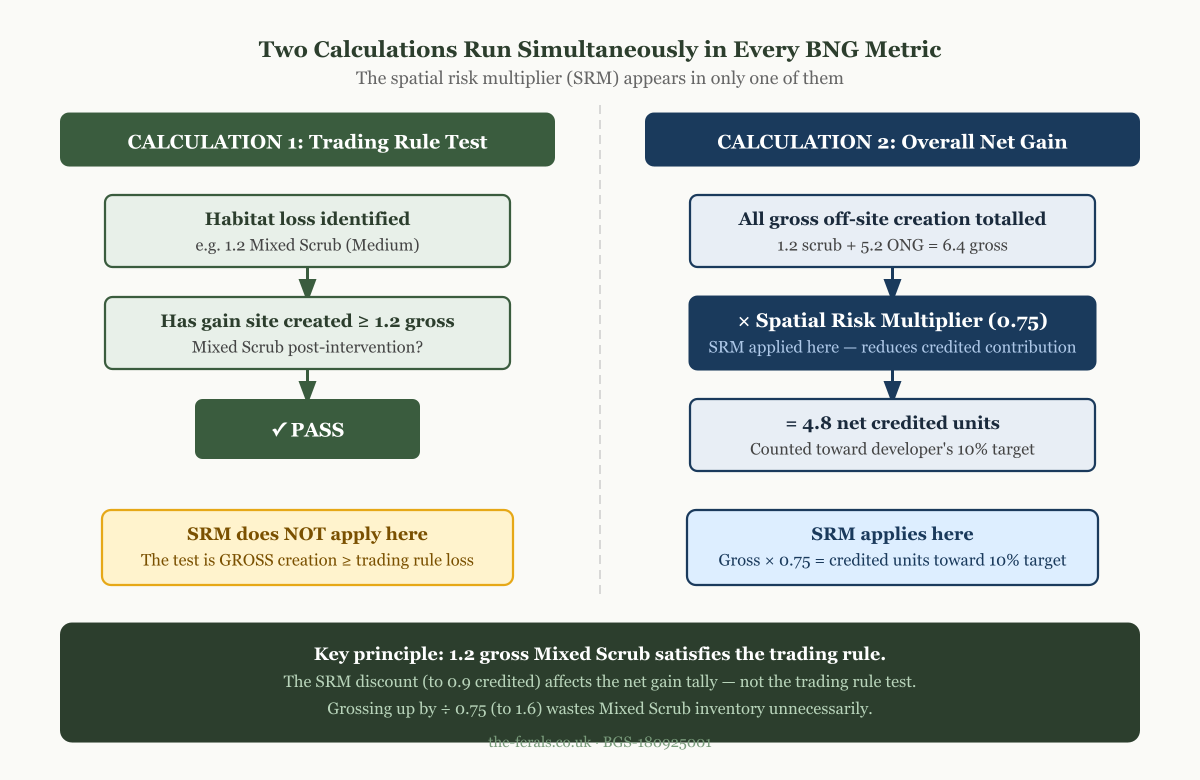
Two calculations are running simultaneously in every BNG metric
The Statutory Biodiversity Metric does two separate jobs at once, and they answer different questions.
The first is the trading rule test. Trading rules require that certain habitat losses are compensated by habitat creation of the same broad type. A loss of Mixed Scrub (Medium distinctiveness) must generally be offset by creation of the same broad habitat category, or by something of higher distinctiveness. The trading rule test asks a simple binary question: has enough qualifying habitat been created off-site to cover the loss? It either passes or it does not.
The second is the overall net gain calculation. This is the running tally that determines whether the development achieves its required level of biodiversity net gain — typically 10% above baseline. It adds up all the off-site creation, applies the relevant multipliers, and checks whether the total meets the target.
These two calculations are not the same thing. The SRM lives in the second one.
The common mistake
Here is where consultants and their clients frequently go wrong.
A development in New Forest District loses 1.2 Mixed Scrub units (Medium distinctiveness). The Trading Summary flags this as a habitat-specific trading rule deficit. The development is sourcing off-site units from a registered habitat bank in Dorset Council area — neighbouring LPA, so SRM 0.75 applies.
The incorrect approach goes like this: "The developer needs 1.2 Mixed Scrub credited units. Our habitat bank has an SRM of 0.75. So we need 1.2 ÷ 0.75 = 1.6 gross Mixed Scrub units to deliver 1.2 credited."
This logic sounds reasonable. But it is wrong — because it applies the SRM to the trading rule test, and the trading rule test does not use the SRM.
Where the SRM actually sits
The trading rule is satisfied by gross post-intervention habitat creation of the qualifying type at the gain site. The metric asks: has the gain site created at least 1.2 gross Mixed Scrub units? If yes, the trading rule passes. The SRM has no role in that question.
The SRM enters the calculation when the metric works out what those 1.2 gross scrub units contribute to the overall 10% net gain target. At that point, 1.2 × 0.75 = 0.9 credited units are added to the developer's BNG tally. That is a smaller credited contribution than the gross creation would suggest — but the trading rule was already satisfied before that step ran.
The shortfall created by the SRM discount (the gap between what was created and what is credited) is made up by additional flexible habitat — typically neutral grassland or another medium-distinctiveness type — which is also subject to the SRM in the net gain calculation, but does not carry a trading rule requirement.
A worked example
Same New Forest development. Losses include 1.2 Mixed Scrub units. Overall BNG deficit requiring off-site supply: 4.8 net credited units. Habitat bank SRM: 0.75.
Correct approach:
- Trading rule requires: 1.2 gross Mixed Scrub creation at the gain site ✓
- Net credited from that scrub: 1.2 × 0.75 = 0.9 units
- Remaining overall deficit: 4.8 − 0.9 = 3.9 net credited units to be filled by flexible habitat
- Gross Other Neutral Grassland needed: 3.9 ÷ 0.75 = 5.2 gross ONG
- Total gross units created at the gain site: 1.2 scrub + 5.2 ONG = 6.4 units
- Total net credited: 6.4 × 0.75 = 4.8 units ✓
The trading rule tests gross creation at the gain site — not units purchased. Units purchased equal gross creation minus the gain site's D-1 baseline for that broad habitat type. Where Mixed Scrub is being newly created from cropland or improved grassland, the D-1 baseline for that category is zero and the two figures are identical. The distinction matters only where the gain site already carries some habitat in the same broad type.
Incorrect approach (SRM applied to the trading rule):
- Trading rule calculation: 1.2 ÷ 0.75 = 1.6 gross Mixed Scrub (wrong)
- Net credited from that scrub: 1.6 × 0.75 = 1.2 units
- Remaining overall deficit: 4.8 − 1.2 = 3.6 net credited ONG needed
- Gross ONG: 3.6 ÷ 0.75 = 4.8 gross ONG
- Total gross: 1.6 scrub + 4.8 ONG = 6.4 units
- Total net credited: 6.4 × 0.75 = 4.8 units ✓
Notice that the total gross units (6.4) and the total net credited units (4.8) are identical in both approaches. The overall maths balances either way. The difference is entirely in the split between habitat types — and that split matters.
Why the split matters in practice
The practical consequences of misapplying the SRM to the trading rule are threefold.
First, inventory allocation. Mixed Scrub is a scarcer habitat type than neutral grassland. Registered habitat banks typically hold far more neutral grassland units. Specifying 1.6 gross Mixed Scrub instead of 1.2 draws down 33% more of that limited inventory unnecessarily. On a small deal this may be inconsequential; aggregated across multiple sites it creates real scarcity pressure on specific-habitat supply.
Second, unit purchase agreements. The agreement specifies the physical units being sold — the gross habitat creation committed to under the S106 and Natural England allocation. Specifying 1.6 scrub in the agreement when 1.2 would satisfy the trading rule means the landowner is committing to more habitat management than the planning system requires.
Third, pricing and negotiations. Where habitat types carry different unit prices (which is increasingly common as specialist habitats like orchards, veteran trees, and hedgerows command premiums), misspecifying the scrub allocation affects the total cost in ways that are not immediately obvious from the metric output alone.
A note on the Statutory Metric user guide
The Defra Statutory Biodiversity Metric User Guide (July 2025) describes the trading rule as requiring compensation to the point of no net loss — not 10% net gain. The 10% net gain target kicks in afterwards, once trading rules are satisfied. This sequencing confirms that trading rule satisfaction is a prior, separate test from the net gain calculation, and therefore sits outside the SRM's scope.
The SRM is defined in the metric as a discount applied to off-site units when they are entered into a gain site metric — it reduces the credited contribution to the development's biodiversity metric. It does not change the amount of habitat that must physically be created to satisfy the habitat-specific trading obligation.
What this means when instructing a habitat bank
When you are sourcing off-site units for a development with a habitat-specific trading rule deficit, the correct instruction to the habitat bank is:
- Identify the trading rule deficit from the Trading Summary tab — not the headline overall deficit
- Ask the habitat bank to allocate that exact gross amount of the qualifying habitat (e.g. 1.2 gross Mixed Scrub)
- Ask the habitat bank to fill the remaining overall deficit with flexible habitat (typically neutral grassland), grossed up by ÷SRM to account for the multiplier penalty
- Verify the total net credited units (total gross × SRM) against the overall BNG deficit
The purchase agreement should specify the gross physical units being sold — the scrub figure at the trading-rule amount, and the flexible habitat at whatever gross figure is needed to clear the overall deficit. The net credited total is the product of those gross figures and the SRM, not an independently negotiated number.
The Ferals: mixed scrub and neutral grassland available for cross-boundary developments
The Ferals is a registered biodiversity gain site (BGS-180925001) in Tarrant Keyneston, Dorset, operating under a 30-year S106 agreement with Dorset Council. We hold both Other Neutral Grassland (Medium distinctiveness, 400+ units) and Mixed Scrub (Medium distinctiveness) on the register, making us one of the few habitat banks in the region able to satisfy both a trading rule deficit for scrub loss and the overall net gain requirement from a single site.
For developments in Bournemouth, Christchurch and Poole, New Forest, Wiltshire and Somerset, the SRM of 0.75 applies. We are familiar with cross-boundary metric preparation and can provide unit breakdowns — gross physical units by habitat type and the resulting net credited contribution — in a format that drops directly into your gain-site metric.
If you are working on a metric with a mixed scrub or neutral grassland trading rule deficit, get in touch. Include your completed Statutory Metric 4.0, the development LPA, and an indication of timescale — we will come back to you within two working days.
You can also see available units and indicative pricing on our units page.